Posts

Chapter 12 : RESTORED LÊ DYNASTY

  https://www.sjvietnam.org/wp-content/uploads/2020/04/Restored-Le-Dynasty-.wav   After Nguyễn Kim passed away, his son-in-law, Trịnh Kiểm (1503-1507) succeeded him, conspiring to kill the Nguyễn family to usurp all the power. The Trịnh family became increasingly powerful. Nguyễn Hoàng (1525-1623), a son of Nguyễn Kim, had to seek refuge in the remote Thuận Hóa region (nowadays Quảng Bình, Quảng Trị, Thừa Thiên Huế). In 1592, the South Court’s [...]
Read more...

Chapter 11 : MẠC DYNASTY

  https://www.sjvietnam.org/wp-content/uploads/2020/04/Mac-Dynasty.wav   After the death of Emperor Lê Thánh Tông, the Court became corrupted. Benighted and brutal, like Lê Uy Mục and Lê Tương Dực, appeared, pushing people into a dark and miserable life. Peasant-led rebels took place throughout the kingdom. Seizing this chance, Mạc Đăng Dung (1483-1541), a general in the court of emperor Lê Chiêu Tông (ruling from 1516 [...]

Read more...

Chapter 10 : LATER LÊ DYNASTY

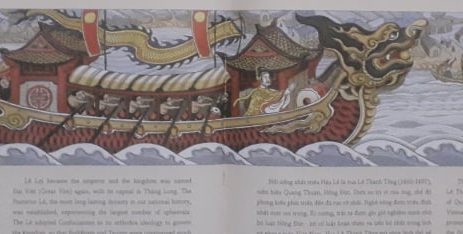
  https://www.sjvietnam.org/wp-content/uploads/2020/04/Later-Le-Dynasty-.wav   Lê Lợi became the emperor and the kingdom was named Đại Việt (Great Viet) again, with its capital in Thăng Long. The Posterior Lê, the most long-lasting dynasty in our national history, was established, experiencing the largest number of upheavals. The Lê adopted Confucianism as its orthodox ideology to govern the kingdom, so that Buddhism and Taoism were constrained [...]

Read more...

Chapter 9 : MING DOMINATION

  https://www.sjvietnam.org/wp-content/uploads/2020/04/Ming-Domination-.wav   Nobles of the Trần Dynasty and local leaders rose up in arms everywhere, from plains to midlands and the mountainous areas. The largest and most enduring insurrection, Lam Sơn, was launched and led by Lê Lợi (1385-1433) in 1418. After ten years, in 1428, Lam Sơn insurgent troops liberated Thăng Long and regained the national independence. Chinese invaders were driven [...]

Read more...